





















About the Project
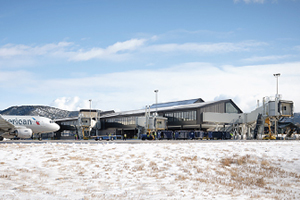
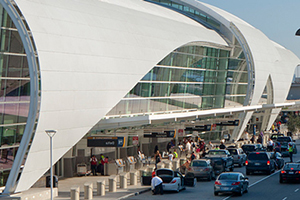
At the Asheville Regional Airport (AVL) located in Asheville, North Carolina, Hensel Phelps is leading the AVL Terminal Building Modernization. This transformative project combines construction technology, collaboration and technological innovation to enhance the passenger experience and improve airport efficiency.
As the 10th busiest regional airport in the United States, AVL serves more than two million passengers each year, supports over 10,000 jobs and contributes $2.26 billion in annual economic impact to the region. The modernization project is expanding AVL’s capacity and amenities to meet rising demand while setting a new benchmark for technology-driven aviation construction in the Southeast.
This multi-phase project will transform AVL’s single-story, seven-gate terminal into a two-story facility with 10 gates equipped to support “Group 3” aircraft, growing the building footprint from approximately 115,000 SF to 275,000 SF.
The AVL Terminal Modernization is strategically phased to maintain full airport operations throughout construction. Temporary gate spaces, tenant relocations and upgraded baggage systems will be implemented before older systems are taken offline, ensuring a seamless experience for travelers and tenants.
Learn how Hensel Phelps delivers complex construction solutions across markets by visiting our Projects Page.
“The team did a great job providing modeling and views in an expedited timeframe to meet the needs of the federal requirements for the airspace studies and determinations by the FAA. Without having these capabilities, we would not have been able to quickly address issues and show adjustments to the FAA to ensure a quick determination turnaround.”
– LEXIE FARMER, C.M., M.P.A., CHIEF OPERATIONS OFFICER
Challenge

At the heart of the modernization zone stands AVL’s aircraft control tower, which must remain active throughout construction. This presents significant challenges for construction scheduling, as maintaining uninterrupted airport operations and clear airfield visibility is paramount.
Any new structures must not obstruct the tower’s sightlines of the runway or taxiways during key phases, requiring meticulous planning, real-time coordination and creative problem-solving.
Solution
During the early preconstruction phase, the Hensel Phelps team recognized the need for clear, visual tools to communicate the complex phasing and sequencing to the owner and stakeholders. Leveraging 4D Building Information Modeling (BIM), which integrates 3D models with time-based scheduling and logistics, the team developed detailed, animated simulations illustrating multiple construction scenarios. These 4D BIM visualizations allowed the owner’s group to easily compare “North-to-South” and “South-to-North” phasing strategies, evaluate operational impacts and visualize how construction would progress over time. This proactive use of digital modeling improved understanding, reduced uncertainty and supported data-driven decision-making.
Taking innovation a step further, the team implemented Augmented Reality (AR). By superimposing 4D visuals directly into the real-world view from the control tower, the owner’s group could experience the project from a first-person perspective. This revealed exactly when and where new construction might obstruct views, helping the team determine the optimal placement for the project’s tower crane and reducing risks to airfield operations.

Results

4D BIM and AR delivered early, real-world visibility into phasing and operational impacts, allowing stakeholders to identify sightline conflicts before they became field issues. The approach helped protect uninterrupted control tower visibility, maintain normal airfield operations and accelerate stakeholder alignment on sequencing and crane placement.
Together, these tools improved collaboration, reduced risk and supported data-driven decision-making for successful phased delivery; setting a new benchmark for technology-enabled aviation construction.


Related Projects
-
Aviation project
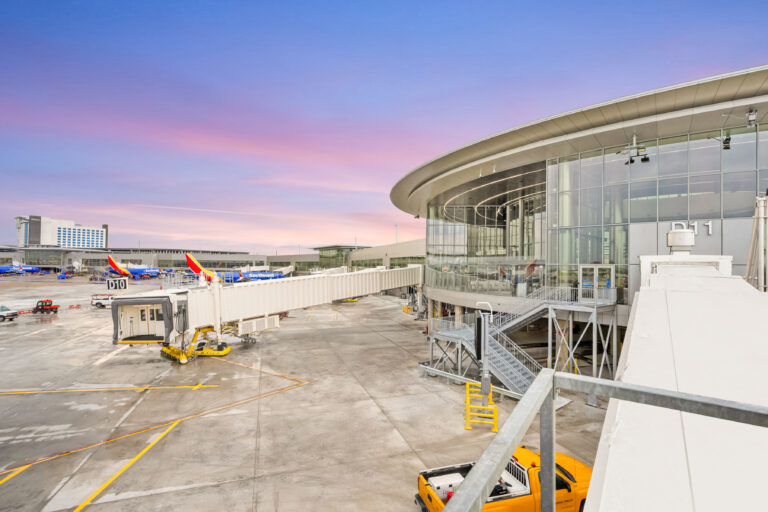
Nashville International Airport (BNA) – Concourse D Extension and Concourse A Reconstruction Learn More -
-

-
-
-
Aviation project
Nashville International Airport Terminal Lobby and International Arrivals Facility Learn More


