


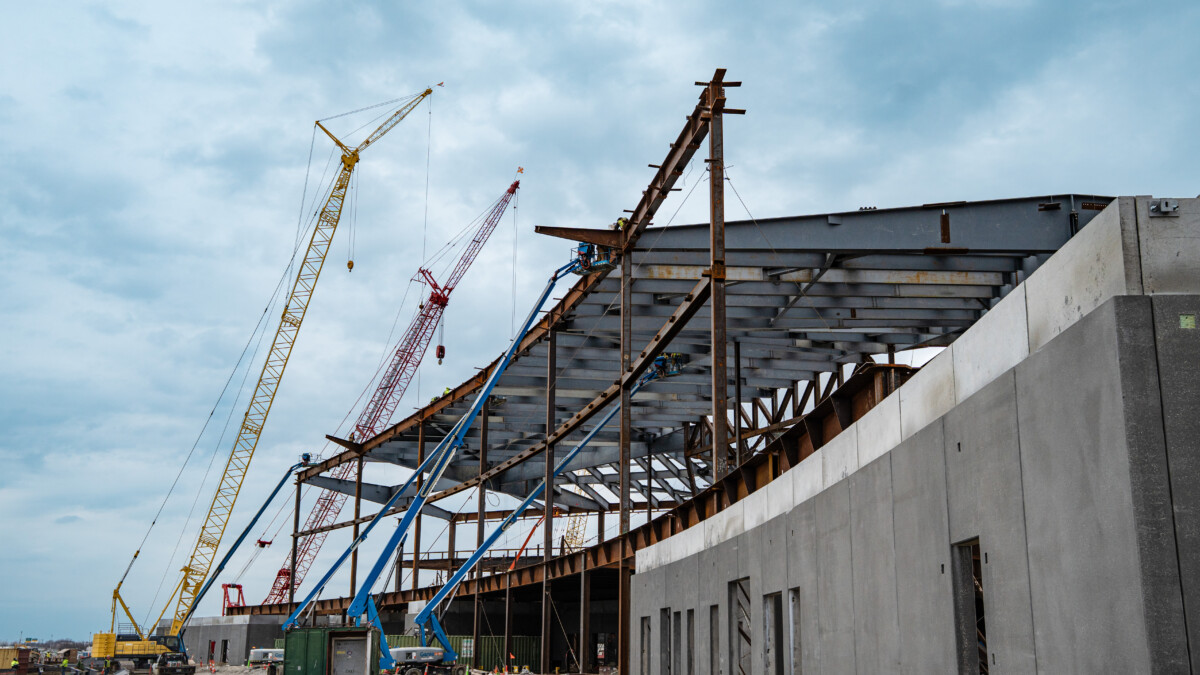
Airport terminal construction programs carry large budgets, fixed opening dates and very little room for surprises. With so much at stake, owners evaluating a contractor must answer one fundamental question: How will the selected contractor ensure the project remains on track? Answering this question takes innovative thinking that challenges conventional approaches, anticipates risks and creates opportunities for greater efficiency.
While innovation in construction is often associated with emerging technologies, its greatest impact frequently comes from rethinking how those technologies, processes and partnerships are applied. As Harry Flatt, virtual design and construction (VDC) engineer on Hensel Phelps’ Port of Seattle Baggage Optimization Phase 3 (BOP3) project, explains, laser scanners and 3D printers are common tools across the industry. “The innovation on BOP3 is the process developed to use them.”
That idea runs through three Hensel Phelps airport construction projects, where teams are applying innovative approaches to solve distinct challenges. In Seattle, new applications of existing technologies are improving construction processes. In Columbus, Ohio, an innovative delivery approach is creating opportunities for greater efficiency. And in San Antonio, strategic contracting and coordination are helping teams navigate project complexities.
Seattle-Tacoma International Airport (SEA): A One-Time Fix for a Recurring Problem
The $437 million Port of Seattle Baggage Optimization Phase 3 project is the final step in consolidating six independent baggage screening systems into one. Much of the work happens in the bagwell, a space packed with conveyors, utilities and structural steel. To support clash detection, as-built verification and scaffold hanger coordination, the team needed reliable survey control points for laser scanning. Commercial targets cost hundreds of dollars per location, were difficult to install in such a congested space and risked damaging the fireproofing on the structural steel.
Rather than accept those limits, the Hensel Phelps VDC team designed, tested and printed its own targets in-house. Over about 10 design cycles, the team refined a modular system: a reusable frame, a removable spike and a target plate. The spike passes through the fireproofing without scraping it away, so targets install and remove quickly with no repairs needed.

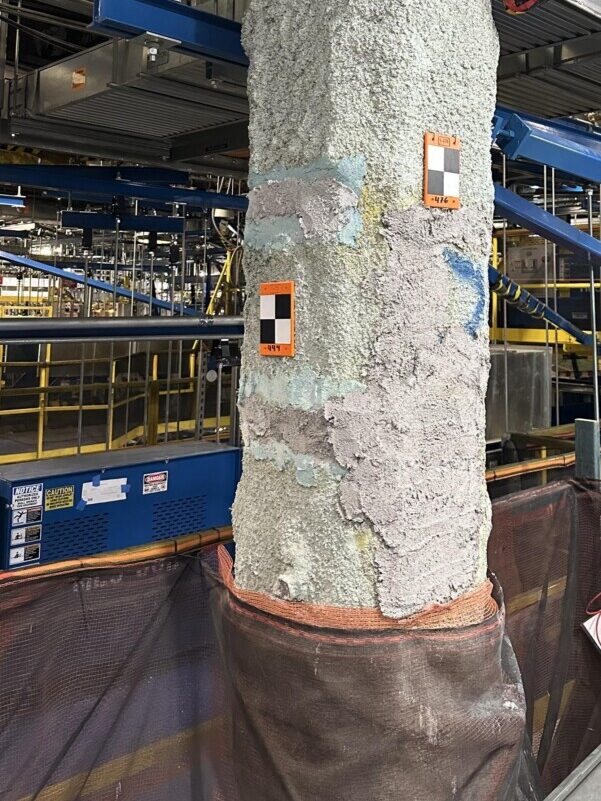
Each target costs about $1.25 to produce. That low cost allowed the team to place hundreds of them throughout the bagwell, creating continuous control in a space where line of sight is scarce. Scan registration that could take a full day now takes minutes, which makes regular progress scanning practical. The result is better quality control, tighter coordination and less rework.
Using laser scanners and 3D printers is not really innovative; every project uses them. The innovation on BOP3 is the process developed to use them in an environment where traditional scanning methods are largely unworkable. Our custom-mounted 3D-printed control targets provide semipermanent control above the scaffold deck, enabling rapid and repeatable scan registration. This reduces a process that could take a whole day down to just minutes, making regular progress scanning feasible on a uniquely challenging site.”
– HARRY FLATT, VDC ENGINEER | HENSEL PHELPS
The solution also travels. The design files can be shared digitally, so any project with a 3D printer can produce the targets without specialized equipment or procurement lead time.
The innovation came from the team’s willingness to rethink how familiar technology could be applied to solve a project-specific challenge. By developing a simple, repeatable solution using existing tools, Hensel Phelps improved efficiency, reduced costs and strengthened coordination while creating an approach that can be replicated across future projects. For the Port of Seattle, that means less rework inside an airport that stays open throughout construction, on the way to a single centralized baggage screening system that can route bags from any ticket counter to any gate.
John Glenn Columbus International Airport: Turning a Field Problem Into a Manufacturing Problem
The New Midfield Terminal at John Glenn Columbus International Airport is a $1.6 billion construction manager at risk project delivered by Hensel Phelps with Columbus-based Elford. The 1 million-square-foot terminal is built to accommodate more than 13 million passengers a year and is scheduled for completion in 2029.
The terminal’s design called for more than 1.5 miles of exterior enclosure: structural masonry on level 1 and stick-built glazing on level 2. Both are proven systems, but both are built piece by piece in the field. On a fast-tracked project beside an active airfield, that meant a large crew in a tight labor market, exposure to Ohio winters, scaffolding congestion and thousands of field-sealed joints to inspect. Because interior trades could not advance until the building was weathertight, the enclosure sat squarely on the critical path.
Working with the Columbus Regional Airport Authority, the design team and enclosure trade partners, the project team moved much of that work off site. Level one now uses large architectural precast panels built in a plant and craned into place. Level two uses unitized wall units, with glass, framing and metal panels assembled and checked in the shop before they arrive. Design-assist sessions, performance mockups and early fabrication releases validated both systems before full production, so fabrication could start before the building was ready to receive them.
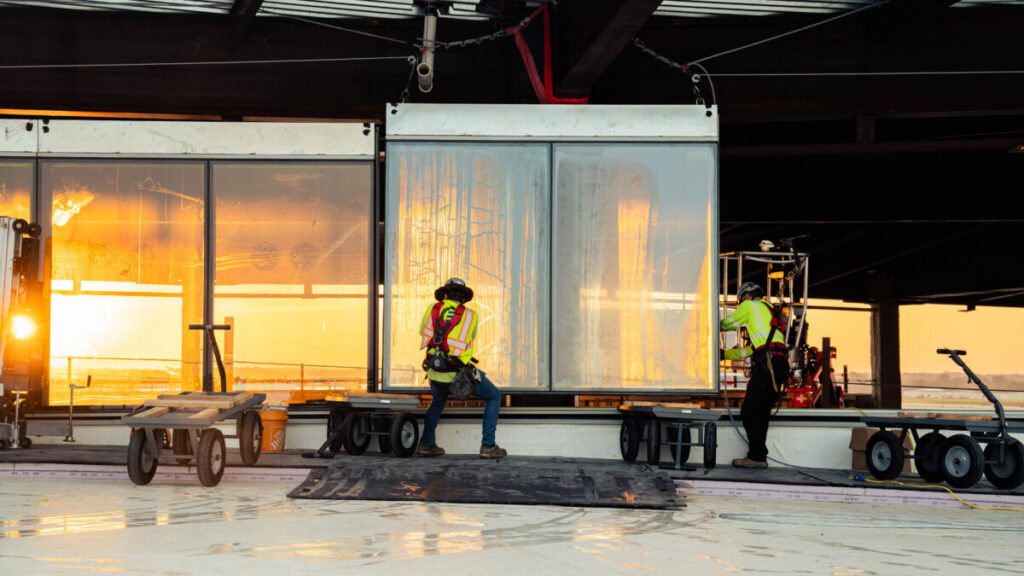
The results are measurable. Installation time dropped by 70 percent and field labor needs fell by more than 90 percent compared with traditional methods. Curtain wall and metal panel costs came down 21 percent, and precast in place of structural masonry reduced costs by 26 percent. Less weather exposure, less congestion and more quality control before components reached the site all help accelerate dry-in and keep interior work moving.
The innovation was not in the enclosure systems themselves, but in rethinking how and where the work could be performed. By challenging traditional construction sequencing and engaging partners early, Hensel Phelps transformed a critical-path activity into an opportunity to improve efficiency, reduce costs and accelerate delivery—all while creating greater schedule certainty for the airport owner.
San Antonio International Airport: Resolving Conflicts on Paper, Not in the Air
At the San Antonio International Airport Terminal Development Program, Hensel Phelps is integrating about 157,500 square feet of mass timber with structural steel. The structure includes 538 cross-laminated timber (CLT) panels and 339 glue-laminated timber (glulam) beams, with much of the Douglas fir left exposed in the finished terminal.
That combination created a coordination risk. The construction team designed the steel-to-steel connections while the design team designed the timber connections, yet both systems had to fit together precisely. Exposed timber also meant sprinkler piping and other systems needed finishes that complemented the wood, and the timber had to be protected from moisture until the building was enclosed.
The team chose to resolve those issues before construction began. Structural steel and mass timber trade partners joined the project during design. Over about six months, the team held weekly design-assist meetings and three workshops lasting eight to 10 hours each, identifying conflicts and settling details before construction documents were issued.
The team also simplified the contract structure. Hensel Phelps contracted directly with LeJeune Steel Company, which managed the steel erector and mass timber supplier Timberlab. Three major scopes sat under one relationship, giving the team a clearer path for purchasing, communication and decisions.
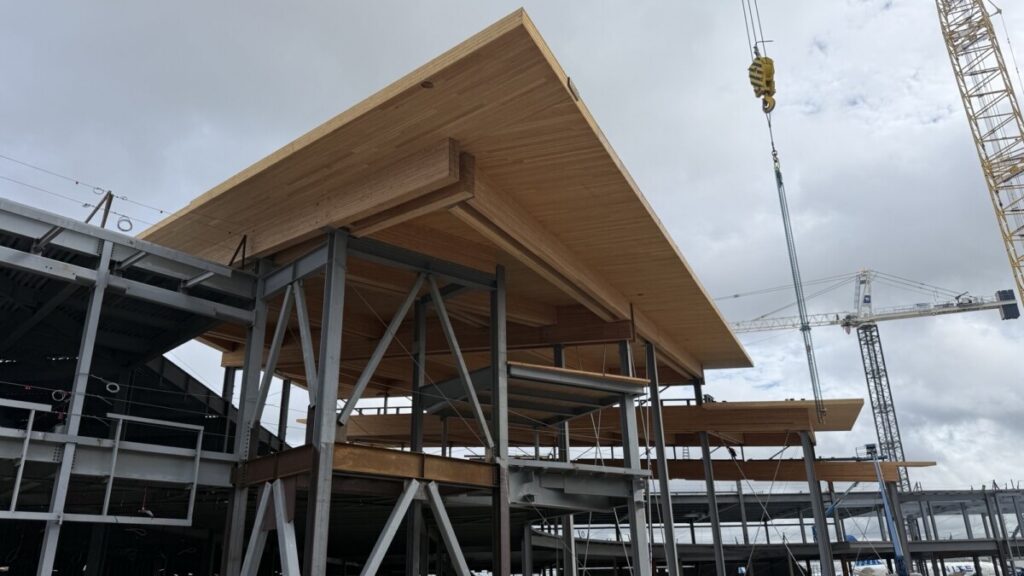
The approach kept the work moving. LeJeune came under contract in July 2025, and materials arrived on site by December 2025. Over about 10 months, the team installed 7,200 tons of structural steel, 1,100 tons of steel decking, all 538 CLT panels and all 339 glulam beams. The structure topped out on October 14, 2026. When rain carried rust from unfinished welds onto nearby timber, Timberlab’s maintenance procedures restored the wood, and the team added prompt protection of welds near exposed timber to its process.
The biggest lesson from the SAT Terminal Development Program is that mass timber works best when it is planned as part of the overall project from the beginning, not just treated as another building material. Early purchasing, detailed coordination, good quality control, and careful moisture protection are key to making it successful on any project.”
– MARK FLEWELLING, PROJECT MANAGER | HENSEL PHELPS.
“The biggest lesson from the SAT Terminal Development Program is that mass timber works best when it is planned as part of the overall project from the beginning, not just treated as another building material,” said Mark Flewelling, project manager for Hensel Phelps.
The innovation came from rethinking how the teams responsible for the mass timber and structural steel could collaborate and execute the work. By aligning trade partners early, simplifying contracting relationships and resolving challenges before they reached the field, Hensel Phelps reduced coordination risks, improved decision-making and created greater certainty for the owner in delivering a complex terminal structure.
What Airport Owners Should Ask Their Contractor About Innovation
The three projects differ in region, scope and discipline. One team worked in VDC, one in building enclosure and one in structural procurement. Yet each made the same move: identify the risk early, decide differently how the work gets done and resolve it before crews reach the field. That consistency is what turns innovation into certainty. For owners planning a terminal program, these projects suggest four questions worth asking any contractor:
- When a field condition makes the standard approach unworkable, how does your team develop its own solution?
- Which scopes can move off site, and when will you validate them with mock-ups?
- How will you bring key trade partners into design, and who owns each connection and purchase?
- How do lessons from one project reach your teams on the next?
The answers may reveal whether innovation is part of how a contractor works or just something it talks about. Explore Hensel Phelps’ aviation projects to learn how the company helps owners resolve risk before it reaches the field.


