

When Sand Island Wastewater Treatment Plant (WWTP) Secondary Treatment Phase 1 entered startup, the project team faced a critical challenge: establishing a healthy biological treatment process as quickly and reliably as possible.
Rather than following a standard approach, the team implemented a data-driven activated sludge seeding strategy that dramatically accelerated the startup process. By sourcing approximately 150,000 gallons of carefully selected seed sludge, conducting extensive system validation and closely monitoring biological performance, the team reduced startup time by an estimated four to six weeks.
The result was a faster path to operational readiness, reduced startup risk and a strong foundation for long-term plant performance. Behind that achievement was a coordinated effort involving advanced testing, microbial analysis and collaboration among project partners across Hawaii.
A Data-Driven Approach to Sludge Seeding
Activated sludge seeding plays a critical role in wastewater treatment startup. The process introduces an established microbial population into a new treatment system, allowing biological processes to stabilize more quickly and efficiently.
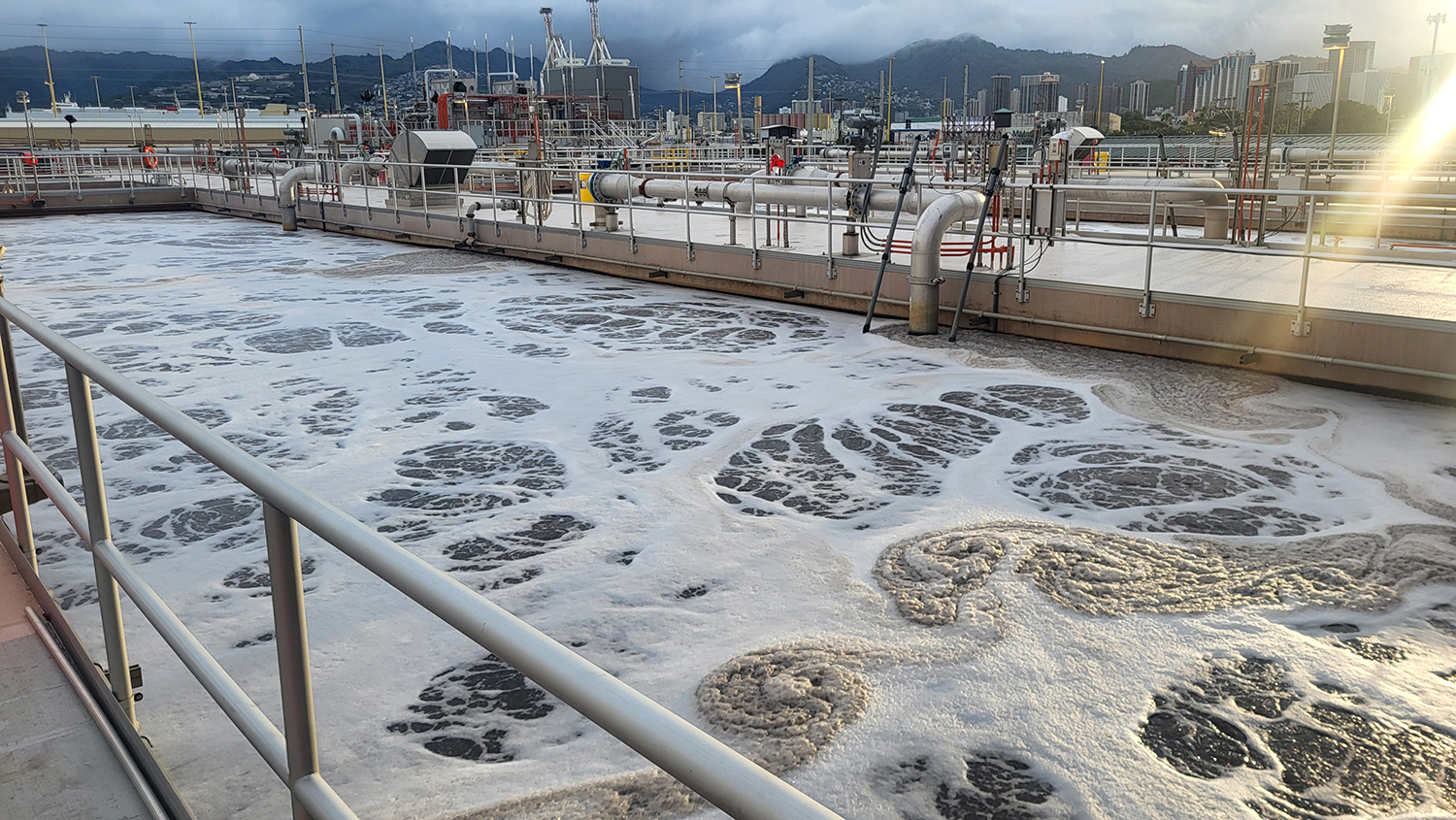
For the Sand Island WWTP project, the team took a deeper look at how seeding could be optimized. Through microscopic evaluations and solids analyses conducted across multiple wastewater treatment facilities, the team identified the strongest available microbial population and selected the Honouliuli Wastewater Treatment Plant as the source.
Based on those findings, approximately 150,000 gallons of seed sludge were transported to Sand Island, five times the volume originally specified for the project.
The increased seed volume was a deliberate decision designed to accelerate biological stabilization and reduce uncertainty during startup. By establishing a larger and healthier microbial population early, the project team positioned the facility to move more quickly into performance testing and operational readiness.
Proving the System Before Startup
Before any seed sludge was introduced, the team at the Sand Island Wastewater Treatment Plant executed functional completion testing and clean water testing to ensure the system was fully prepared to support the biological process.
This phase focused on verifying that all process systems, equipment and controls were functioning as intended—eliminating uncertainty and reducing the risk of startup disruptions once live microorganisms were introduced.
A key component of this effort was clean water testing, performed in multiple phases to simulate operational conditions and confirm system performance. This included validation of both secondary treatment processes and the thickener building. Early testing identified equipment issues that required correction and retesting—ultimately strengthening system reliability prior to seeding.
In parallel, the team conducted extensive equipment and instrumentation validation, including point-to-point checks of all control and monitoring systems in coordination with the City & County of Honolulu. This ensured that alarms, trends, and system responses were fully operational and visible through the wastewater plant’s supervisory control and data acquisition (SCADA) system, enabling real-time monitoring once biological treatment began.
By the time activated sludge seed was introduced, the plant was not just “ready”—it was proven. This disciplined validation approach minimized startup risk, protected the health of the microbial population and enabled a smoother transition into full biological operation.
A Controlled Five-Day Sludge Seeding Operation
Working within an active wastewater treatment facility required careful planning and execution. The startup sequence followed a phased approach:
- Conducted full system validation, including equipment testing, SCADA integration and clean water testing
- Introduced process water only after confirming system readiness
- Maintained a closed-loop system during initial seeding to protect microbial health
- Transitioned to full operational treatment by opening flow to the membrane bioreactor (MBR) system
The entire seeding process was completed over five continuous days. Throughout the process, recirculation systems helped maintain optimal biological conditions.
Quality Control of Wastewater Microbiology
Once the microbial population was introduced, maintaining biological health became a primary focus.
The project team continuously monitored key performance indicators, including microbial activity, solids concentration, dissolved oxygen levels, temperature, nutrient availability and automated control responses.
Success was defined by stable biological performance, consistent system trends and the ability to transition into the automated control strategy by design.
Potential risks—such as microbial die-off during transport or system instability during startup—were mitigated through careful planning, real-time monitoring and thorough pre-seeding validation effort. Throughout the process, the team continued to monitor all equipment and instruments, SCADA integration and clean water testing, recording alarms and trends to ensure system readiness.
The result was a controlled startup process that protected the biological system while supporting reliable operational performance.
Coordinating a Successful Activated Sludge Seeding Process
Beyond the technical execution, the success of the seeding process was driven by strong coordination among stakeholders. The project team worked closely with the City & County of Honolulu, AECOM, the operations team and partners, and trade and treatment technology manufacturers throughout the process.
Structured commissioning plans, readiness reviews and regular coordination meetings helped align stakeholders around project goals, system readiness and operational expectations. This collaborative approach allowed decisions to be made efficiently and ensured all parties remained focused on achieving a successful startup.
Setting The Foundation for Long-Term Performance
Startup activities may occur over a relatively short period, but their impact can extend throughout the life of a facility.
By establishing a strong microbial population early and validating system performance before introducing biological treatment, the project team created conditions that supported long-term reliability from day one.
Although wastewater treatment systems naturally develop and adapt over time, a successful startup provides the foundation necessary for stable operations, maintainability and performance.
Lessons For Future Wastewater Projects
The Sand Island effort highlighted several key considerations for future wastewater startups:
- Seed sludge quality and variability matter—ongoing testing is essential.
- More seed can accelerate schedule, but must be balanced with cost and system constraints.
- Early validation and coordination reduce downstream risk.
- Operational alignment is just as important as technical execution.
The Hensel Phelps team will continue supporting operations and performance testing as the project advances toward final commissioning and acceptance. The successful startup at Sand Island demonstrates how careful planning, technical expertise and partnership can accelerate project outcomes while establishing a strong foundation for long-term success.
Learn more about our ongoing work in Hawaii and explore Hensel Phelps water / wastewater projects across the U.S.
This article was developed with insights from Allie Ackerman Operations Manager; Franklin Amador Integration Manager; Joseph Palaszynski Integration Manager; Brad Musick President of Wastewater Solutions, Inc. (WSI).


