

Building Information Modeling (BIM) has transformed how projects are designed and constructed, but its value does not have to end at turnover. Through advanced Virtual Design and Construction (VDC) practices, Hensel Phelps leverages BIM, reality capture and digital twin technology to deliver accurate, data-rich models that support facility operations long after construction is complete. By connecting project information to real-world conditions, Hensel Phelps helps owners improve asset management, streamline maintenance and preserve critical knowledge for the future.
Hensel Phelps’ Typical BIM/VDC Approach
BIM and VDC work together to improve project delivery and provide greater value to owners. BIM serves as the digital representation of a facility, containing the geometric and data-rich information used throughout design and construction. VDC is the process of leveraging that information to coordinate teams, improve constructability, reduce risk and support informed decision-making throughout the project lifecycle. Together, BIM and VDC create the foundation for advanced solutions such as digital twins, which extend the value of project data well beyond construction completion.
Owner Concept
The process begins with the owner providing a federated BIM model that represents the conceptual design and intent of what will be built. This model serves as the basis for coordination and development, allowing the team to visualize the facility and establish a clear path forward before work reaches the field.
Trade Partner Coordination
As design progresses, trade partners refine the federated model by contributing discipline‑specific BIM content. During virtual coordination sessions led by a VDC coordinator, the project team collectively reviews building systems and resolves conflicts between trades before construction begins. This process establishes a coordinated, constructible plan that all parties approve prior to field execution.
Owner Review and Approval
Once coordination is complete, the owner reviews and approves the updated BIM model, ensuring it meets project requirements before work continues.
As‑Built Verification Through Reality Capture
While this process already provides significant value, Los Alamos National Laboratory (LANL) requested an enhanced deliverable. Instead of a traditional as‑built model, the client wanted a fully interactive Digital Twin that could be serve as a long‑term operational tool.
Digital Twin Construction in Practice
Although coordinated BIM models represent design intent, real‑world construction conditions are rarely perfect. Walls may not be square, materials vary and field adjustments are often necessary. Project teams usually record these changes with redlined drawings, which owners can find hard to interpret and challenging to rely on for future renovations or expansions.
Hensel Phelps developed the digital twin to overcome these limitations by providing an accurate, intelligent model of the facility as it exists in the field.
Creating A Digital Twin Construction Model
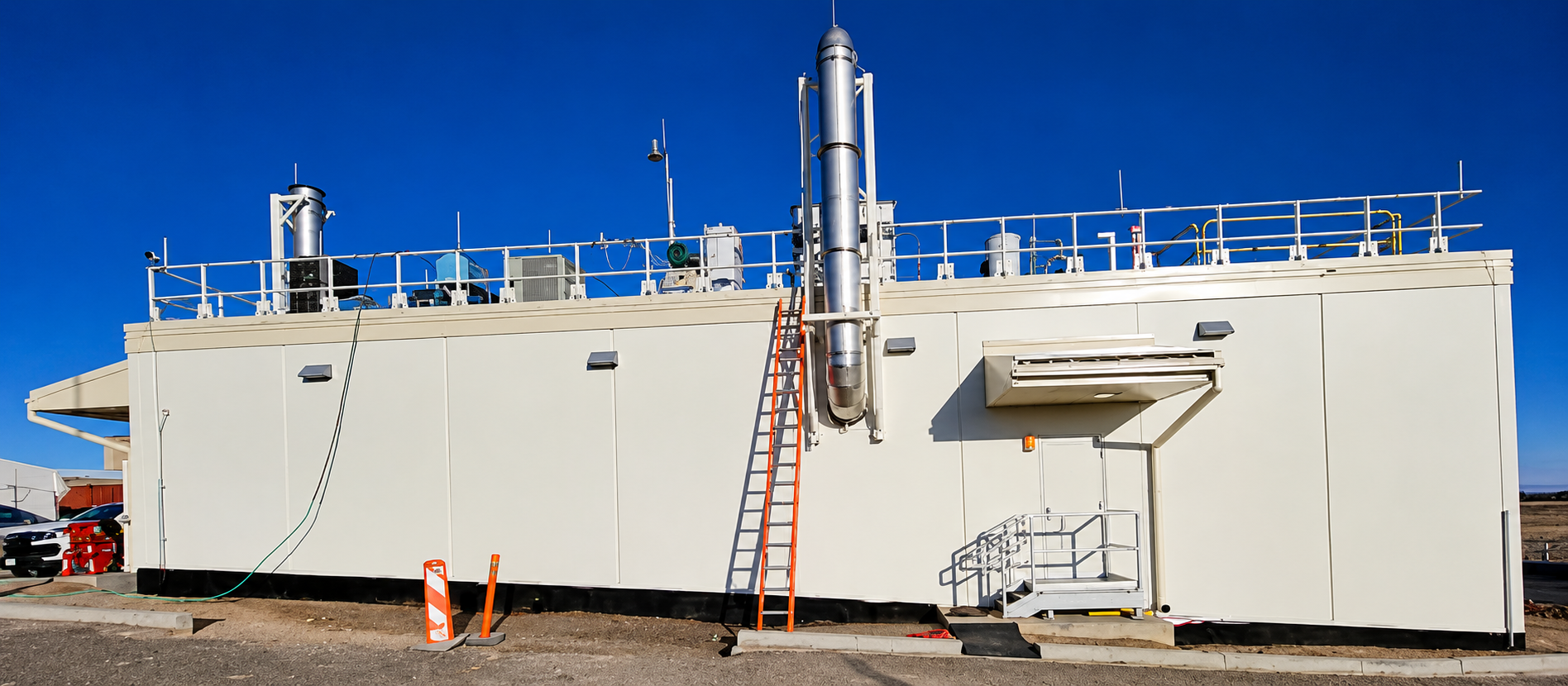
For the LANL TA‑50 Transuranic (TRU) Liquid Waste (TLW) Facility project, Hensel Phelps used laser scanning technology to capture existing conditions. Each scan captured tens of millions of data points, which the team stitched together to produce a complete three‑dimensional model of the built environment. From this point‑cloud data, the team created an as‑built model that reflects what was physically constructed rather than what was originally planned. This model provides a reliable starting point for future work and minimizes the risk of relying on outdated record drawings.
Making Facility Information Accessible
To support long-term facility operations, the digital twin adds intelligence to the model. The project team embedded detailed information into individual assets and building components, including manufacturer data, circuit and panel connections, warranty documentation, maintenance requirements, installation notes and associated design changes. For this project, equipment data was organized through a Master Equipment List (MEL), with modeled objects linked directly to their corresponding documentation. By selecting an element in the model, users can instantly access all relevant information for that asset.
In high‑security environments like LANL, security requirements restrict access to certain backend systems. Despite this, the project team fully implemented the digital twin and trained the owner’s team to manage it internally by linking equipment to their MEL.
This approach centralizes construction and operational data that would otherwise be scattered across drawings, submittals, RFIs and manuals. Instead of searching through multiple systems, owners and facility operators can navigate the model, visually locate equipment and retrieve the information they need in one place.
Supporting Smarter Facility Operations
The digital twin also lays a foundation for future growth. Although this effort did not include live sensor integration, the platform can support real‑time data such as temperature, occupancy, equipment performance and maintenance alerts. In more advanced applications, digital twins can enable predictive maintenance, early issue detection and better operational decision‑making by linking modeled assets to live data feeds.
Turning Project Data into a Lasting Asset
At its core, the digital twin serves as a digital repository of project knowledge. Construction generates a significant volume of information, and without a structured method for capturing it, critical details can be lost at turnover. The digital twin preserves that information and gives owners a tool to support facility management long after construction is complete.
Rather than simply delivering a building, Hensel Phelps delivers a building supported by a digital twin that improves operations, maintenance and long‑term asset management. This method closely aligns with Hensel Phelps Services and reinforces Hensel Phelps’ commitment to delivering lasting value beyond project completion.
As owners seek more efficient ways to manage increasingly complex facilities, digital twin construction offers a powerful tool for preserving project knowledge, improving operations and supporting long-term asset performance. Hensel Phelps continues to leverage BIM, VDC and digital twin technology to help clients unlock greater value throughout the facility lifecycle. Learn more about Hensel Phelps’ integrated VDC capabilities.


