

Owners across every market are asking the same question: how do we deliver more buildings, faster, without sacrificing quality or blowing the budget? Nowhere is that pressure sharper than in military housing, where aging barracks and dormitories need replacement at a scale ‘traditional’ construction delivery methods struggle to match.
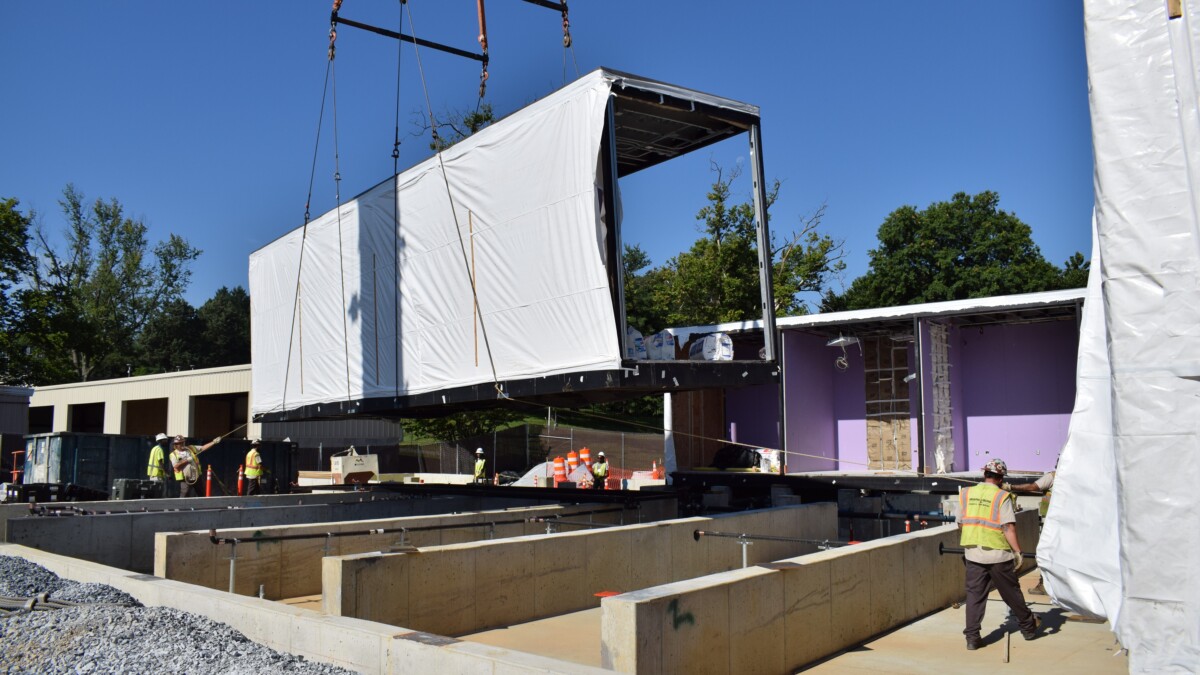
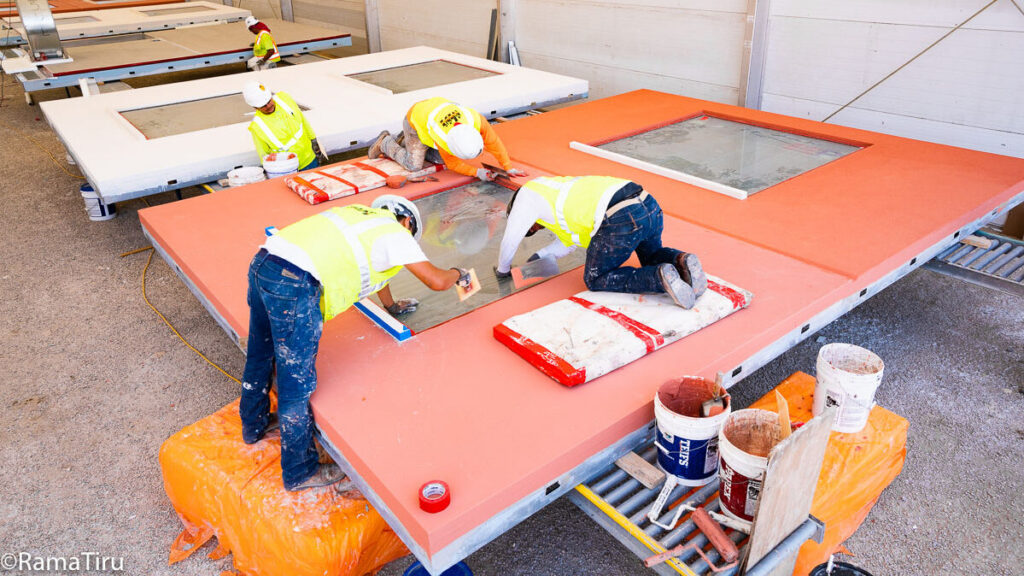
Industrialized Construction (IC) is one of the most promising answers. IC applies manufacturing principles to building delivery. Repeatable components such as bathroom pods, panelized walls, prefabricated mechanical, engineering and plumbing (MEP) racks and precast structural elements are built in controlled factory settings while site work moves forward in parallel. The result is a shorter schedule, less dependence on scarce field labor and more consistent quality.
The key is treating a building as a repeatable product rather than a one-off project, and bringing designers, manufacturers and builders together early enough to make that possible.
Shaping the Conversation for Military Construction
Hensel Phelps, along with government, industry and academic partners, recently contributed to “Industrialized Construction Opportunities for the Department of War,” a 2026 report from the Society of American Military Engineers (SAME).
The report lays out the state of the domestic IC industry and provides a practical playbook for applying it on military projects. Among its findings, a 2025 study commissioned by the U.S. Army Corps of Engineers (USACE) and the Naval Facilities Engineering Systems Command (NAVFAC) identified a 68% cost premium on military barracks compared to similar private-sector housing. The SAME report points to early team integration, standardized prototype designs and multiyear program thinking as the path to closing that gap.
Hensel Phelps has applied many of these same strategies to deliver complex facilities more efficiently, including military housing.
Building Military Housing 25% Faster with Industrialized Construction
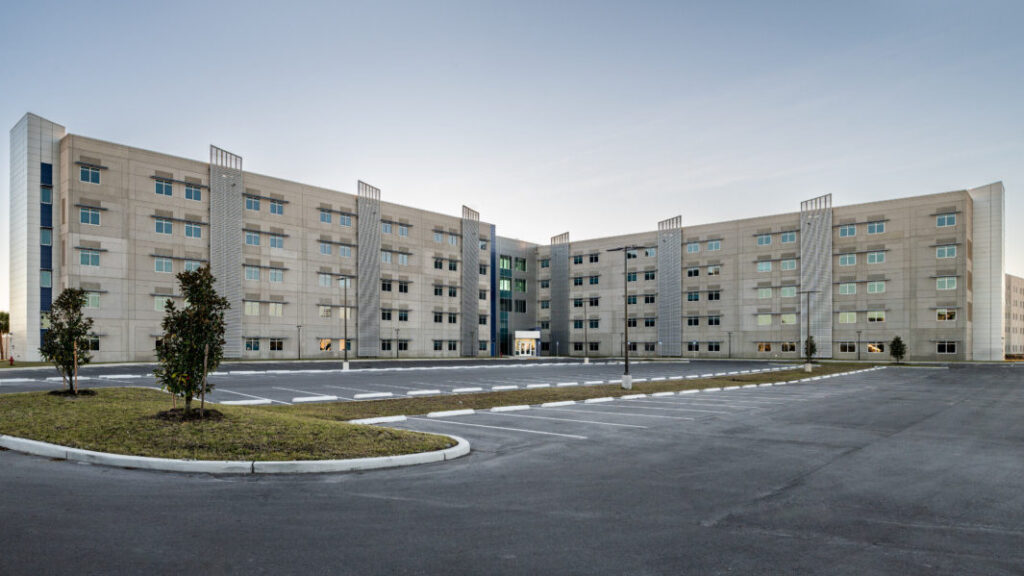
In October 2018, Hurricane Michael escalated from a Category 2 to a Category 5 storm and swept through the Florida Panhandle. At Tyndall Air Force Base, more than 400 buildings were destroyed or damaged beyond repair, and only three dormitory facilities were left standing. As part of the base rebuild, the USACE Mobile District awarded Hensel Phelps the $136 million Dormitories project.
The project delivered two five-story buildings with 240 rooms each, housing 480 permanent military personnel. Along with dorm rooms, the facilities include administrative support spaces, community activity areas, theater and meeting rooms, kitchenettes, laundry and storage. Both buildings are designed to withstand 165 mph hurricane-force winds.
Industrialized strategies were central to the schedule. The dormitory wings were designed to be identical across all disciplines, and the team paired a precast structure with offsite-racked mechanical, electrical, plumbing, fire alarm and telecommunications systems. Prefabricating those systems kept long-lead equipment from driving the critical path. The dorms opened in April 2025, delivered roughly 25% faster than a traditional approach.
Using Prefabrication to Accelerate Student Housing Delivery
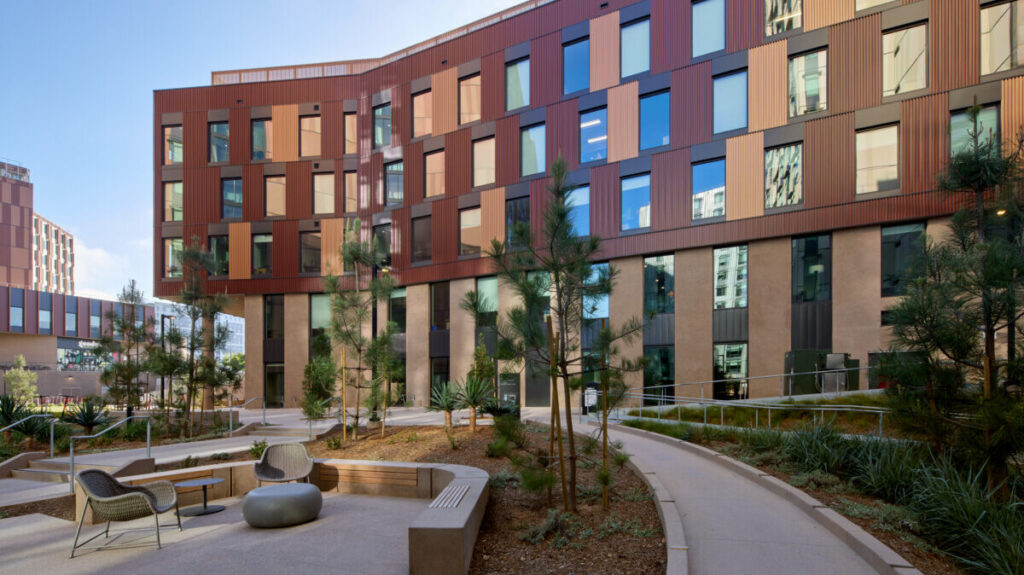
At UC San Diego, Hensel Phelps served as design-build prime on the Ridge Walk North Living and Learning Neighborhood Project, a mixed-use neighborhood for Thurgood Marshall College. Three residence halls, ranging from 10 to 18 stories, provide more than 2,445 student beds alongside an economics building, lecture halls, administrative space and community programs including a Basic Needs Center, e-Sports Center and Goody’s Cafe + Amazon Just-Walk-Out Market. New plazas along Ridge Walk connect the neighborhood to the Historic Grove, Geisel Library and the heart of campus.
On a project of this size, repetition is the opportunity. The team built the towers around a standardized floorplate and reusable prefabricated formwork, turning each floor into a repeatable production cycle rather than a new puzzle. The project was completed in November 2025, approximately 20% faster than conventional delivery, with an all-electric design targeting LEED Gold. It shows that IC is not limited to modular boxes, and that industrialized thinking can transform a cast-in-place concrete structure too.
Industrialized Construction in Hospitality: Lessons for Military Housing
A hotel tower is built on the same logic as barracks or residence halls: hundreds of nearly identical rooms stacked floor after floor. That makes hospitality a proving ground for industrialized methods that translate directly to federal housing.
Kalahari Resort & Convention Center
In Round Rock, Texas, Hensel Phelps delivered the $385 million Kalahari Resort, a destination that pairs an 11-story, 975-room hotel with a 223,000 square foot indoor water park, an 80,000 square foot theme park and a 200,000 square foot convention center. With nearly 1,000 guest rooms to build, the team employed an industrialized construction method. Factory-finished bathroom pods were crane-set and installed as finished assemblies. The resort opened in November 2020, roughly 25% faster than would have been possible with traditional delivery.
Limelight Boulder Hotel & Conference Center
On the University of Colorado Boulder campus, Hensel Phelps built the $164 million Limelight Boulder, a 6-story, 252-key hotel and conference center on a tight zero-lot-line site. Above the second level, the team used the Infinity wall system, a prefabricated cold-formed steel structural wall panel system, to accelerate construction and improve thermal performance. A full-scale model room built offsite allowed the ownership team to test and refine the guest room before construction began, the same prototype-first approach the SAME report recommends. Delivered under a construction manager-at-risk model with design-assist trade partners, the all-electric hotel opened in August 2025.
The Integrator Makes It Work
IC brings more specialized partners into a project: designers, manufacturers, logistics providers and field crews whose work must meet at precise connection points. As the SAME report notes, that complexity calls for a central integrator who owns the plan from design through turnover.
Hensel Phelps serves as that central integrator, bringing experience from more than 110 projects delivered using IC and kit-of-parts methods, including bathroom pods, panelized assemblies, prefabricated MEP systems and repetitive concrete forming. This experience across commercial and federal markets enables Hensel Phelps to apply proven private-sector construction strategies to federal projects while addressing the unique requirements, regulations and mission priorities of government facilities.
As the federal government looks to commercial construction practices to accelerate delivery, improve cost certainty and maximize taxpayer investment, Hensel Phelps brings experience from both sectors to help meet these goals. By adapting proven IC strategies to the unique requirements of federal projects, Hensel Phelps is helping improve how critical infrastructure is delivered while maintaining quality, performance and accountability.


